Each process in the pharmaceutical industry should be based on accepted procedures and standards of quality. Any little mistake may impact the quality of products, patient safety, or regulations. That is why the companies watch and document everything unexpected in the process of manufacturing, testing, packaging or storage.
This article will inform you what a deviation is, the key examples of deviations in the pharma world, and a few real-life examples.
What Is Deviation in the Pharmaceutical Industry?
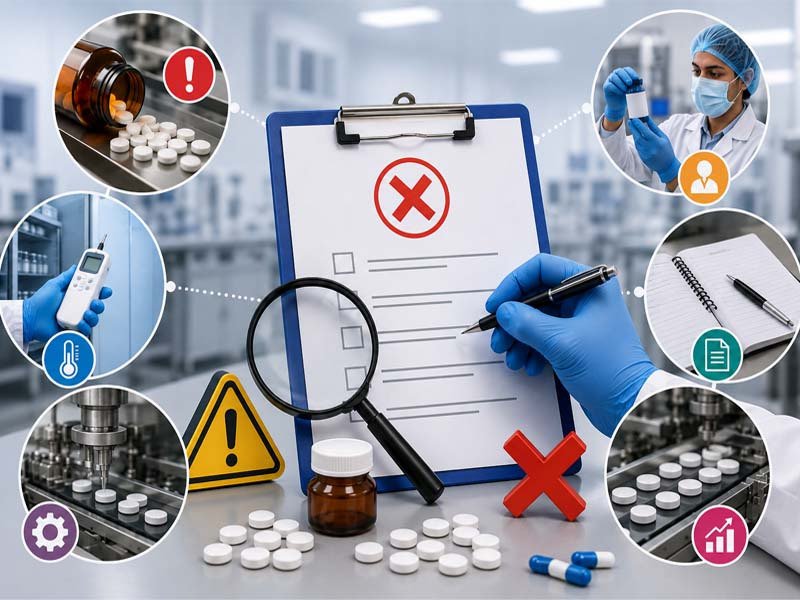
Deviation in the pharmaceutical industry is defined as anything that is in opposition to a process, procedure, specifications or standard that is approved. It occurs when an activity does not happen as planned or documented.
As an example, when a machine works at a temperature exceeding the authorised temperature range during tablet production, it can be termed a deviation.
The principal aim of deviation management is to:
- Protect product quality
- Ensure patient safety
- Meet regulatory requirements
- Determine the source of the problem.
- Avoid such issues moving forward.
4 Types of Deviation in Pharma

1. Planned Deviation
An approved planned deviation is made prior to the activity. It applies where there is a justifiable cause for following another procedure temporarily without compromising the quality of products.
Example:
Another testing instrument is employed by a production team due to the normal testing equipment being in maintenance. Before production commences, Quality Assurance (QA) reviews and approves the change.
2. Unplanned Deviation
An unplanned deviation occurs suddenly in either the manufacturing process or the laboratory. Such deviations must be reported and inquired into.
Example:
Power outage halts the manufacturing process, leading to a setback in tablet compression.
3. Minor Deviation
Minor deviation makes a small or insignificant difference in product quality, safety, or regulations. Although the risk is minor, it has to be reported.
Example:
One of the operators forgets to add the time on a production record, but later does it sometime after, in the correct correction measure.
4. Major or Critical Deviation.
Major or critical deviation may directly influence product quality, patient safety or response to regulatory guidelines. Such variations must be studied and rectified.
Example:
Sterile manufacturing space loses environmental control in the production process, making it prone to product contamination.
Quick Summary of Deviation Types
| Type | Description | Example |
| Planned | Approved before the activity | Using approved backup equipment |
| Unplanned | Happens unexpectedly | Machine breakdown during production |
| Minor | Low impact on quality | Small documentation error |
| Major/Critical | High impact on quality or safety | Sterility failure during manufacturing |
Real-Life Examples of Deviations in Pharma
Deviation management is an aspect of daily functioning within the pharmaceutical manufacturing industry.
The following are some typical real-world examples.
Temperature Excursion During Storage
Medicines are stored within approved temperature limits. When the temperature exceeds the permissible range due to the malfunction of the refrigeration, a deviation increases. The products concerned undergo pre-release assessment.
Improper weighing of Raw Materials.
An operator puts more active ingredient than defined in the batch record. Immediately, production is halted, and the deviation is examined to determine the possibility of proceeding with the batch or being rejected.
Equipment Failure
One of the tablet compression machines fails during production. The maintenance team handles the repairs of the equipment, and the Quality Assurance determines whether the interruption impacted the ready-produced tablets.
Missing Documentation
After a production operator has fully completed an operation, they forget to sign a batch manufacturing record. Even though the manufacturing stage has been performed well, the absence of the signature is reported as a deviation since proper records cannot be ignored in pharmaceutical production.
Laboratory Test Outside Acceptance Criteria.
In quality control testing, a test sample yields results that are not within the approved range. This variation is explored to reveal whether the problem is tied to the samples, testing procedure, instrument or the production process.
The proper cleaning procedure was not followed.
Once production is finalised, equipment cleaning is done on the incorrect cleaning cycle. The equipment will not be used until the problem is examined, and the cleaning will be done again.
Conclusion
Deviation in the pharmaceutical industry is any form of deviation from the approved procedures, specifications or processes. Deviations might be minor or major, planned or not, but all need proper documentation and investigation.
Learning through real-life deviations and making corrective steps, pharmaceutical companies can continuously improve their operations and minimise future risks.