
Medicines should be safe and effective. It is essential to have consistent quality and no contamination. Even small mistakes may affect the quality of medicine, the right dosage, and patient safety. That is why pharmaceutical companies follow GMP.
According to the WHO, GMP minimizes risks during manufacturing which are difficult to eliminate by conducting tests of the final product.
The 5 pillars of GMP in the pharmaceutical industry are easy to remember and represent the key quality aspects.
What Are the 5 Pillars of GMP?
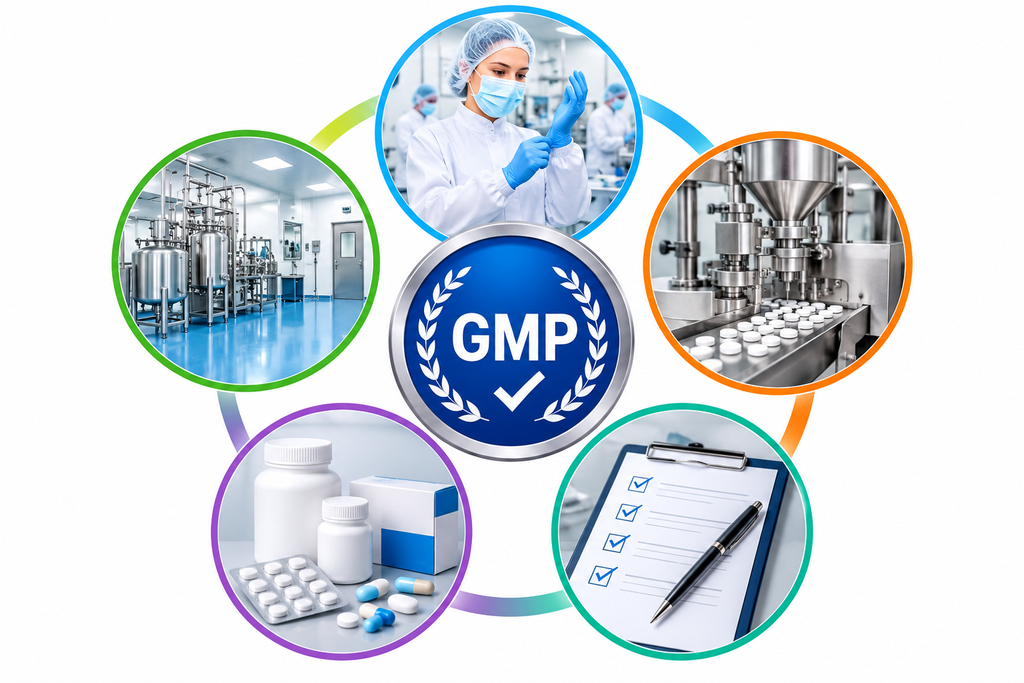
People, Premises, Processes, Products, and Procedures are usually called the 5 Ps of GMP.
1. People
They are responsible for providing quality throughout pharmaceutical manufacturing. Employees should know their responsibilities.
The following points should be included in the manufacturing process:
- Regular training for GMP compliance.
- Personal hygiene.
- Appropriate protective clothing.
- Responsibilities for qualified employees.
- Immediate reporting of any mistake or any concern related to quality.
For instance, employees of sterile manufacturing areas should be able to follow strict personal hygiene and gowning rules.
2. Premises
Facilities for manufacturing should allow the manufacturing process to be carried out safely.
Poorly maintained facilities are likely to put medicines at risk of being contaminated by dust, microorganisms, and other contaminants.
The following points belong to GMP premises’ requirements:
- Clean and maintained production areas.
- Suitable ventilation and environmental controls.
- Separate spaces for activities causing potential risks of cross-contamination.
- Cleaning and sanitation.
- Suitable conditions for storing raw materials and medicines.
It helps to protect employees and product quality.
3. Processes
All manufacturing steps should be controlled and followed by approved processes.
From mixing of ingredients to the packaging of medicine, all manufacturers should ensure consistency.
The following points are key elements of GMP for processes:
- Validation of manufacturing processes.
- Monitoring of critical parameters of manufacturing.
- In-process quality control.
- Investigation of any deviations in manufacturing.
- Control and review of process changes.
For example, during the manufacturing of tablets, it is necessary to monitor such parameters as weight and compression of tablets.
4. Products
Quality starts with materials used for manufacturing and ends with the release of the finished product.
Manufacturers should ensure that raw materials, packaging materials, and finished products are of high quality.
Such important points should be taken into account:
- Testing and approval of raw materials.
- Qualification of suppliers.
- Checking the identity, purity and strength of products.
- Prevention of any error in labelling and packaging.
- Quality control prior to release.
All manufactured batches should be of consistent quality.
5. Procedures
They are intended to help employees conduct the manufacturing process consistently.
Instructions for manufacturing are usually referred to as Standard Operating Procedures (SOPs).
Among GMP documents are:
- Manufacturing and packaging instructions.
- Procedures for cleaning and maintenance of the equipment.
- Testing instructions.
- Batch manufacturing record.
- Deviation and corrective actions report.
For example, if equipment should be cleaned after each batch manufacturing, there should be written instructions with an explanation of the required procedure and records.
Such documentation allows tracking problems and investigating quality issues.
How Do Pharmaceutical Companies Ensure GMP Compliance?
Ensuring GMP compliance requires regular checks rather than preparation for inspections. The company conducts internal audits, reviews manufacturing records, and monitors adherence to procedures. Also, quality control monitors any manufacturing errors and recurrence of problems, as well as the effectiveness of corrective actions.
Having identified the problem, it is required to establish the reason for such a problem and to take measures which will prevent its further occurrence.
It is necessary for manufacturers to minimize manufacturing risks, comply with quality requirements and produce medicines safely.
Why Are the 5 Pillars of GMP Important?
The observance of these 5 principles allows pharmaceutical companies to:
- Minimize contamination and manufacturing errors.
- Provide consistent quality of medicine.
- Protect patients’ health and safety.
- Comply with relevant regulatory requirements.
- Increase production efficiency and accountability.
The requirements for manufacturing are established by regulatory authorities, for example, by the FDA.
It is a useful learning tool even though full GMP requirements cover more points.
Conclusion
The 5 pillars of GMP in the pharmaceutical industry help manufacturers to understand how people, premises, processes, products, and procedures interact to provide product quality.
Observing these principles helps manufacturers to minimize risks, comply with quality requirements and produce high-quality medicines.